

AI vs human social media managers: what the Instagram test showed
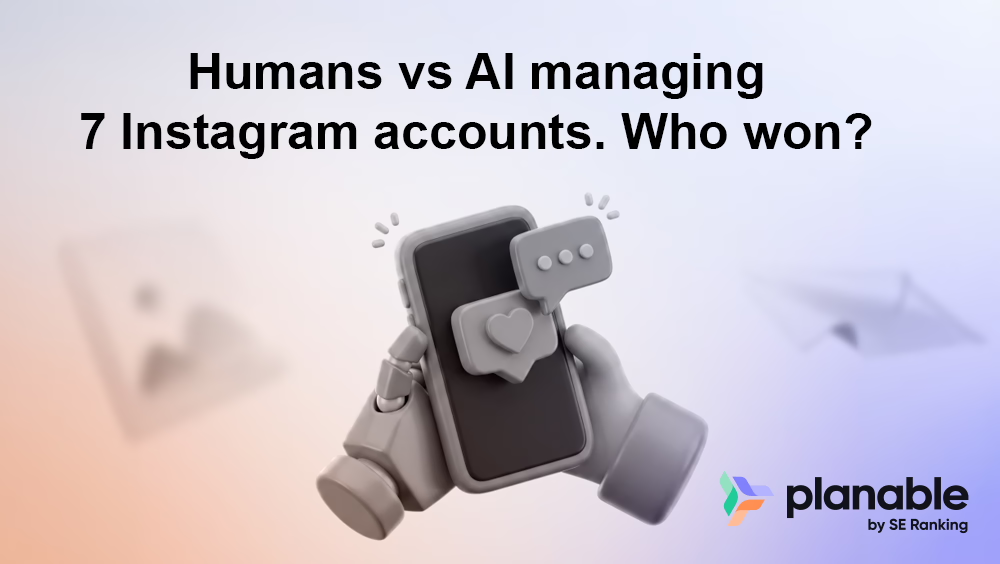
Planable ran seven Instagram accounts for the same fictional chocolate brand. Some were managed by humans, some by AI. Humans won clearly on engagement, mainly because they did the bit AI skipped: real conversation.
Jump on over to the Planable website for all the details
Otherwise, if you’re far too busy and important, read on for a quick summary:
AI vs human social media managers: what the Instagram test showed
Planable ran seven Instagram accounts for the same fictional chocolate brand. Some were managed by humans, some by AI. Humans won clearly on engagement, mainly because they did the bit AI skipped: real conversation.
The headline numbers
- Human accounts averaged 1.88% engagement.
- AI accounts averaged 0.77% engagement.
- Humans delivered 2.45x more engagement.
- Humans got 88 comments.
- AI accounts got 2 comments.
- That is a 44x comment gap.
Why humans won
- They replied to people.
- They joined conversations outside their own posts.
- They used judgement, not just output.
- One human-run giveaway drove 33 comments on its own.
The useful lesson: posting is only part of social media. Distribution, replies and community work are where the gap opens up.
Can AI replace a social media manager?
Not based on this test. AI can help create posts faster, but it struggled with judgement, scheduling, brand consistency and conversation. A human still needs to decide what is good, fix mistakes and do the community work.
Where AI performed well
- Claude’s best account reached 1.13% engagement.
- ChatGPT created a full 9-post campaign in one reply.
- AI helped with speed, prompts, captions and campaign structure.
- One AI-assisted human account gained the most followers.
So AI was not useless. It was useful as a production tool. It was weaker as the person in charge.
Where AI struggled
- Every AI account made scheduling mistakes.
- One skipped dates altogether.
- One left a placeholder in a caption.
- One described the brand colour incorrectly.
- AI-generated visuals showed obvious flaws.
- The bots did not reply to followers.
Did detailed prompts help?
Not in this test. Shorter briefs beat detailed ones.
- Generic briefs: 0.93% engagement.
- Rich briefs: 0.60% engagement.
- The likely issue: more instruction made output safer and less interesting.
Should social teams use detailed AI prompts or short briefs?
Use enough detail to stop mistakes, but not so much that the output becomes stiff. Give AI the goal, audience, brand basics and constraints. Leave room for human editing, judgement and sharper ideas.
Was AI cheaper?
- Human accounts took 18.5 hours each on average.
- AI accounts took 5.4 hours each on average.
- AI was faster to run.
- But humans earned far more engagement per account.
Cheap output is not the same as cheap results. Cost per engagement matters more than cost per post.
What social media teams should do next
- Use AI for first drafts and production help.
- Keep humans in charge of strategy and approvals.
- Do not automate community engagement blindly.
- Budget time for editing, fixing and replying.
- Measure comments, replies and follower growth, not just posting speed.
What is the best way to combine AI and human social media management?
Use AI to speed up the draft, not to own the account. Let it suggest captions, content angles and campaign structures. Then let a human choose, edit, schedule correctly and talk to people.
The practical takeaway
AI can help a social team move faster. But social media still rewards judgement, taste and showing up. The winning setup is not human or AI. It is AI for production, human for decisions and community.
Source used: Planable’s AI vs human social media manager Instagram experiment. https://planable.io/blog/ai-vs-smm/