

How Mail brings your Digital Brand to Life and Delivers Trust
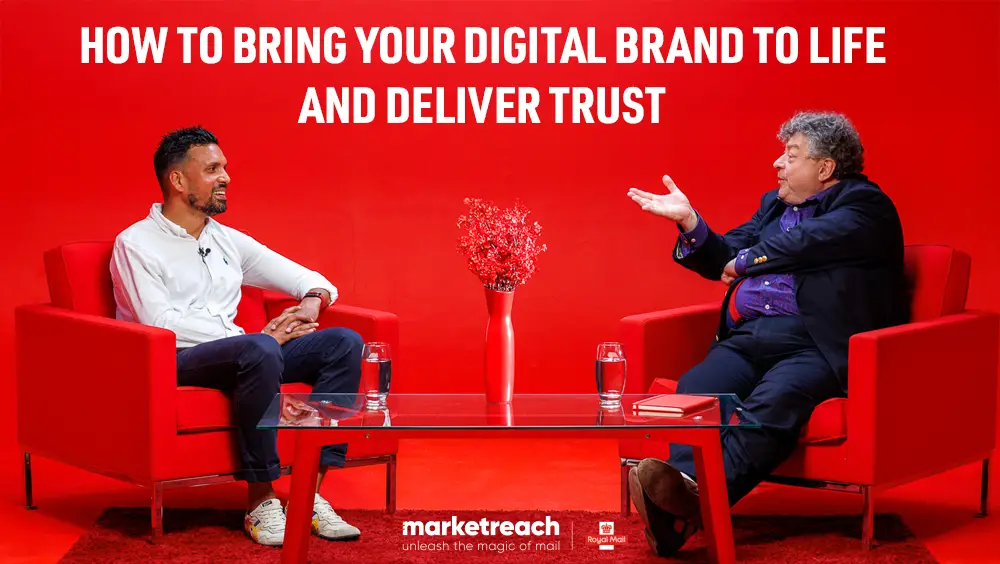
This one’s a fab 12 minute chat (or 5 minute read below) between Rory Sutherland and Smarty Mobile’s Sayed Hajamaideen on how their digital brand is leaning on mail to build trust with their customers. If you’re unfamiliar with the genuine connection-building nature of print and mail, it’s a really insightful watch.
And while we’ve provided a nice, skimmable AI summary below, if you’ve time, we highly recommend you hopping on over to the Marketreach website to watch the video using the link below (if you’ve not encountered him before, Rory’s a bit of a national treasure).
Jump on over to watch the video HERE
ok, as we do, here’s a super short skimmable version for those of us who are time- or attention-limited 🙂
Sayed and his view on mail
Sayed explains his route into marketing started in customer-facing work at O2, then moved into commercial and direct response marketing. He’s held roles across:
- Tesco Mobile
- Scottish Southern Energy
He joined SMARTY Mobile because it was a blank sheet of paper and he wanted the challenge of shaping a brand from scratch.
Why direct mail helps digital-only brands build trust
Rory frames the issue clearly: as an MVNO, SMARTY is largely an intangible brand – no shops, selling connectivity direct.
Sayed’s view: mail and print create trust and credibility because they give a physical presence to a brand that otherwise lives in screens.
A very specific proof point from SMARTY’s experience:
- Their number one organic search term is: ‘are they any good?’
- Sayed says direct mail can help answer that trust question as part of the wider mix.
The role of mail in a modern media mix
Sayed’s thread throughout the conversation is: stop debating channels like they are in a boxing ring and ask a better question.
Ask this instead: ‘What is the role of this channel?’
He describes some channels (especially digital) as great for attention grabbing, which matters when ‘you’ve never heard of us’.
Then comes the follow-on question:
- What do you do with that attention once you’ve got it?
Sayed positions mail as a strong answer because it supports a more focused one-to-one journey.
Why mail creates a one-to-one moment that digital struggles to match
Sayed and Rory describe a few practical reasons mail can work differently:
- Mail arrives at the letterbox and people can take their time with it
- You cannot ‘fragment the letterbox’ – it is not the same distracted environment as online
- With good personalisation, mail can feel more like a relationship starting than an ad impression landing
They also talk about perceived value: if a brand has spent money to write to you, the message can feel more meaningful than online ‘spray and pray’.
Direct mail measurement: attribution and econometrics are useful, but not the whole job
Sayed acknowledges the value of attribution and econometrics, but says marketers also need to:
- educate the business on the right medium for the right purpose
- separate real time (digital feedback loops) from longevity (mail effects over time)
Rory adds a related point using research from WARC: their work on short vs long-term effects did not include direct mail, but it suggested print advertising can be undervalued because longer-term effects are often not measured.
Promises turning into guarantees: mail plus TV or radio
Sayed says TV and radio can make ‘lovely promises’ that capture attention.
Mail can turn that into something stronger because:
- it is written down and delivered directly
- it supports the balance between marketing as a science and marketing as an art rooted in psychology
This is one of the their most quotable ideas: mail helps turn promises into guarantees.
Direct mail personalisation that actually gets noticed
Sayed’s practical advice is refreshingly grounded:
- Mail needs to stand out in the one-to-one moment when people pull out their post
- Even small cues can help, like using a detail that identifies the recipient as more than ‘dear’
In short: personalisation is not just a tactic, it is part of making someone feel the message is for them.
Best-practice advice for marketers testing direct mail
Sayed’s recommendations come through as a simple playbook:
- Test and learn – treat mail as an experiment you can refine
- Know who you’re talking to – be clear on the audience and aim
- Define the channel’s job – attention, reassurance, trust, response, or holding the mix together
- Help the business think in consumer time – not just instant dashboards
Multi-channel marketing effectiveness: why it is not either-or
Toward the end, the conversation lands on a combined-channel view:
- It is rarely about proving one channel beats another
- The strongest outcomes often come from channels working together
- Rory describes a ‘multiplicative’ effect when people encounter a brand in two or three forms, not just an additive one
Sayed links this back to what SMARTY needs most:
- familiarity and trust
- reassurance
- because the SIM pack is the main physical thing people can touch and experience
takeaways: direct mail lessons from SMARTY Mobile
- Direct mail builds trust for digital-only brands by adding physical credibility
- Mail supports one-to-one communication in a calmer environment than digital
- The best channel strategy starts with role clarity, not channel bias
- TV and radio grab attention, mail reinforces belief by writing the promise down
- Personalisation helps mail feel relevant, not generic
- Multi-channel exposure can multiply impact, building familiarity and reassurance faster