

10 Steps to Brochure Design and Printing
Brochures are a great sales tool for businesses of all shapes and sizes. Whether they’re a point-of-sale giveaway, for mail order or for sales support, they’re very much your flexible friend.
Many smaller businesses have particular challenges when creating brochures – limited budgets and a lack of specialist writing and design skills can all be challenges.
But before that even, business owners are often so stuck for time and headspace that they don’t ask the most basic questions from the market to help them accurately target their brochure.
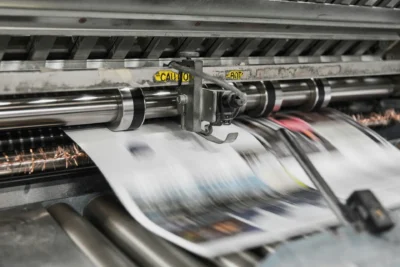
Printed brochures ready to sell. Worth it after all the hard work.
So, here’s 10 points for small businesses and marketers to ensure when they get to the brochure printing phase, they know their brochure is going to hit the mark and really engage with their target audience.
1. Audience
Do you understand who your target audience are? Gender, age and how your product or service fulfils their needs should all colour the message, design, tone and language of your brochure. Ask questions of customers or sales people and create a profile of your target audience to use throughout the process.
2. Purpose
Get a clear understanding on the role your brochure should fulfil. Even if it has a ‘jack of all trades’ role with several uses, it’s important to understand them all so you can ensure the brochure fulfils them adequately. If it does have multiple roles, it’s worth designing then checking the brochure with many hats on to ensure each of these specific purposes are adequately serviced.
3. Involvement
If there’s one truth in writing any marketing communications, it’s that your own perspective of the market can be wide of the mark. It’s therefore worth involving colleagues in a brochure and allowing their opinions to enhance the design, messages and writing too. It also spreads the burden of what can be a very time-consuming project.
4. Copywriting
As a rule-of-thumb, the writing counts for 80% of any marketing communications (see below). Good writing drives sales. It needs to speak in the language of the customer, inform them, influence them, build your brand in their minds and drive them to your predetermined action (such as dropping onto your website and tapping in their credit card details!). It’s a tricky proposition and requires experience and time (and not just ChatGPT!), so is probably not for the faint-hearted, time-limited business owner. Get a pro involved and they’ll pay you back in improved response rates and profitability.
5. Design/Layout
Same goes for the designing and layout. While it’s the writing that carries the majority of the meaning and message of your brochure, the design dictates its impact on the customer and usability of the brochure – and supports and encourages the call to action. It’s therefore just as important and, except for the most basic layouts, is usually not something for an amateur to tackle. Apart from creative considerations (impact and usability especially) ensuring the brochure is supplied in a format which your brochure printer can use can be tricky and cause headaches and increased cost. The moral – get a good designer involved from the outset!
6. Check, Check and Check again!
Quality proofing is just as important as quality writing and designing. Edit aggressively, culling unnecessary words and anything that doesn’t add to your call to action. Sleep on changes and revisit afresh in the morning. Get colleagues to look over and suggest amends. Get several people to check key details such as web addresses and phone numbers. Check out some of our guides to make sure what you see is what you get.
7. Digital Asset Management
Managing a large inventory of digital assets that go in to producing a brochure can be a headache. You might just have a large folder full of assets – and that’s probably fine for a one-off publication. But ongoing when you’re managing multiple versions over time and looking to pull relevant assets through to your next publication, you might well find a digital asset management (or DAM) system will help you store, organise, meta-tag, share and retrieve digital assets a whole lot more quickly.
8. Brochure Printing
Find a quality, service-oriented commercial printing partner who will bend over backwards to help you. Good ones can really add value to your business, for free. You need someone who will give you a great deal; will advise on formats effectiveness and response mechanisms; who will project manage for you; who is a great communicator and keeps you in the loop; who will quickly resolve any issues should they occur and delivers a quality product in the manner you expect.
9. Distribution
Of course, printing the brochure’s one thing, but getting it in front of your customers or prospective customers is probably just as important to your marketing effort. Understanding your letterbox marketing and distribution options – whether to go for direct mail, door drop, programmatic or partially addressed mail for example – and their cost implications, can be very daunting. You can find a good deal of insight on our blog pages of course, but you’d probably be served best by speaking with one of our strategists who are all trained on print marketing and distribution techniques and can advise (for free) on which are your most appropriate options.
10. Return on Investment
Even though it’s a stack of work, printing and distributing your brochure will be worth it in the end. A quality brochure will quickly pay back its production costs and support your business and sales in lots of ways. You can calculate its direct ROI (Measuring ROI from printed marketing materials) which is probably more of a concern as a small business owner than indirect benefits such as brand building.
And (ahem) that’s all there is to it!
Of course, the team at Webmart are always here to help with brochure printing, distribution and all your multi-channel marketing needs.