


The latest JICMAIL report showing the effectiveness of mail in Q1 2026 is here.
Understanding expected response rates before you run a campaign brings obvious benefits. Just like BARB for broadcast and RAJAR for radio, JICMAIL tracks engagement and response rates for all kinds of mail.
Their Q1 2026 results are out and if you’re thinking about direct mail, door drop or partially addressed mail, it’s well worth a look.
You can click the link below to drop straight to the JICMAIL website and find the full pdf report. But if you haven’t got the time, we’ve summarised some of the main findings below.
Intermediate Level. 45 page PDF – probably a 30 minute read if you’re quick.
Grab the PDF over on the JICMAIL website
highlights of the latest jicmail report
Here you go – a quick summary of the report as interpreted by our LLM of the month.
JICMAIL Q1 2026 results: mail keeps proving it can drive digital action
JICMAIL’s Q1 2026 results show mail really gets people to act online. Website visits prompted by mail hit a new Q1 record, 56% of mail-driven purchases were completed online, and direct mail continued to earn over two minutes of attention per item. For brands trying to join up physical and digital journeys, that is useful insight for marketers – so make sure you track those digital conversions.
Mail still gets read, kept, shared and acted on
The report shows that 76.3% of all mail was read, looked at or glanced at in Q1 2026. That is a pretty solid starting point for any channel, especially one that many young people now value so highly (mail’s special to receive, right?).
Mail also continues to hang around in the home. Direct mail items had a lifespan of 7.8 days before being discarded or filed away, while door drops lasted 5.6 days. That gives mail a useful advantage: it is not always a one-second impression. It can sit on the kitchen counter, get noticed again, and be picked up later.
Direct mail delivers repeated exposure
Frequency was broadly stable year on year. In Q1 2026, direct mail received 4.47 interactions per item, while business mail achieved 4.83 interactions. Door drops were lower, at 3.04 interactions, but still showed slight year-on-year growth.
That matters because one mail item creates multiple chances to be seen. It can be opened, put aside, discussed, revisited, filed, recycled or passed on. Try getting that sort of relaxed exposure from a social ad wedged between lunch photos and someone arguing about potholes.
Why does mail still work when so much buying happens online?
Mail works because it gives the digital journey a physical trigger. A customer can receive a catalogue, letter or door drop at home, then search, visit a website, check an account, scan a QR code or buy online later. The important bit is not whether the final purchase happens through paper. It is whether mail helps start or move the decision along.
Mail is creating more digital response
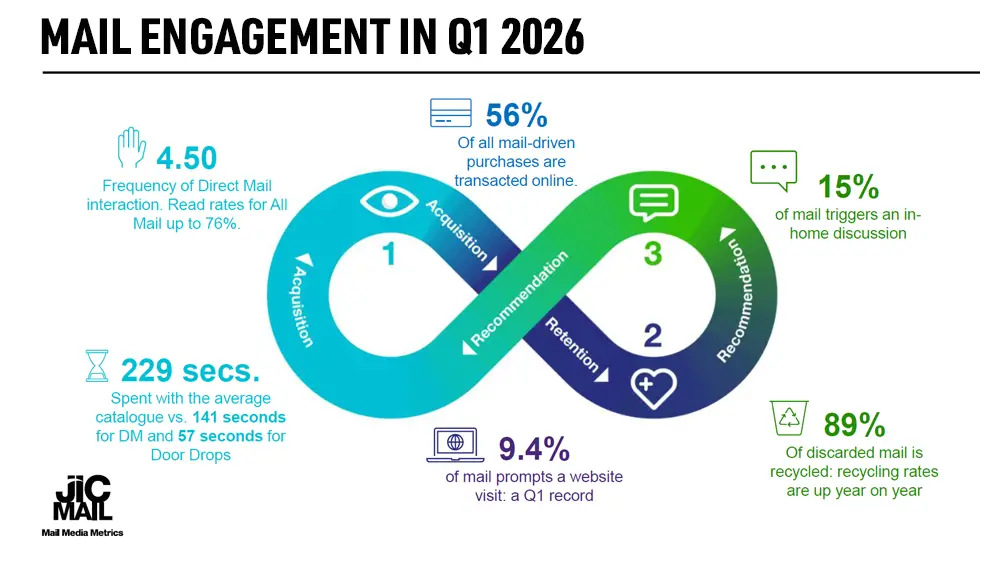
The standout Q1 2026 finding is digital effectiveness. Mail prompted website visits from 9.4% of items, a new Q1 record. The report also shows year-on-year growth in account look-ups, online searches and app downloads after mail exposure.
That makes mail much more than a direct response channel in the old coupon-and-envelope sense. It is a traffic driver. It prompts people to move from the doormat to the website, app, search engine or online account.
More mail-driven purchases are completed online
In Q1 2026, 56% of purchases triggered by mail were transacted online. That was the highest level recorded since this metric began being tracked in Q3 2023.
The useful point for marketers is simple: offline stimulus and online purchase are not separate worlds. Mail can do the attention job in the home, while the transaction happens where customers now prefer to complete it – online.
Catalogues are still attention machines
Catalogues were the strongest attention performer in the report. The average catalogue was viewed for 229 seconds, compared with 141 seconds for direct mail and 57 seconds for door drops.
That makes sense. A good catalogue is closer to a browsing experience than a single message. People dip in, compare, return to it and use it as a prompt for online action. For retail and ecommerce brands, the catalogue is not just a print asset. It is often a shop window that happens to land on the doormat.
Mail also gets households talking
The report highlights that 15% of mail triggers an in-home discussion. That is a useful reminder that mail does not always behave like a private one-person channel. It can be seen by more than one person in a household and can become part of a shared decision.
Item reach shows the same pattern. Business mail reached 1.16 people per household item, direct mail 1.14, partially addressed mail 1.09, and door drops 1.06. Not huge multipliers, but enough to matter when planning reach and frequency.
How should brands measure mail when the sale happens online?
Do not judge mail only by immediate paper-based response. Track what happens after exposure: website visits, account look-ups, online searches, app activity, QR scans and online purchases. The question to answer is did the mail move someone closer to buying, enquiring or returning?
Geo-planning makes mail more targeted
JICMAIL’s newer geo-planning work takes mail measurement down to postcode sector level across around 9,000 GB postcode sectors.
That gives planners a more useful view of where mail performs well. The report highlights that door drop commercial effectiveness is strongest in London and other built-up areas. Direct mail attention is highest in Oxford, Reading and Cambridge postcode sectors.
For campaign planning, this is handy. It means mail can be planned with more local nuance, rather than treated as a blunt national drop.
The Response Rate Tracker adds stronger benchmarks
The Response Rate Tracker now includes full-year 2025 data across cold direct mail, warm direct mail, door drops, and partially addressed mail. It is built from anonymous campaign-level data, including response rate, ROI, cost per acquisition and average order value where available.
- Cold direct mail averaged a 1% response rate and £2.10 ROI.
- Warm direct mail averaged a 6.3% response rate and £8.80 ROI.
- Door drops averaged a 0.3% response rate and £4.00 ROI.
- Partially addressed mail averaged a 0.7% response rate and £2.30 ROI.
Warm direct mail remains the obvious heavyweight here. No surprise really: people who already know you are usually easier to move than strangers. But cold direct mail and door drops still have a role, especially when planned properly and measured against realistic benchmarks.
Retail direct mail showed stronger response in 2025
Retail was a useful bright spot in the tracker. Warm retail direct mail response rates grew in 2025, and cold retail direct mail response also improved while cost per acquisition came down.
The report also compares format performance for warm retail direct mail. A4 formats performed best, with a 9.6% response rate, compared with 6.6% for A5 and 3.5% for postcards.
That does not mean A4 is always the answer. But it does suggest that format, space and creative treatment can make a measurable difference. Bigger is not automatically better, but giving yourself enough room to persuade clearly can help.
What makes a direct mail campaign more likely to get attention?
Attention usually comes from relevance, usefulness and format working together. A piece that looks worth opening, gives the reader a clear reason to care, and makes the next step obvious has a better chance of being kept, revisited or acted on. Creative still matters, but clarity carries a lot of the load.
Share of attention shows who is punching above their weight
The report looks at share of doormat versus share of attention for major advertisers. This is useful because volume alone does not tell the full story. Some brands get more attention than their share of mail would suggest.
- Tesco Clubcard continued to take a disproportionately high share of direct mail attention.
- Farmfoods achieved more than double its share of door drop attention versus share of doormat.
- Nationwide over-performed for business mail attention.
That is a useful planning point. The aim is not just to land on the doormat. It is to earn more attention than your volume alone would predict.
Recycling performance is improving
Mail recycling increased again in Q1 2026. The report shows 89% of discarded mail was recycled, up year on year.
That does not remove the need to plan responsibly. But it does give marketers a more rounded picture when talking about mail’s role in a modern channel mix.
What marketers should take from JICMAIL Q1 2026
The main lesson is that mail is not sitting apart from digital. It is feeding it.
- Use mail to create attention at home, then make the online next step easy.
- Measure digital behaviours caused by mail, not just direct mail responses.
- Use geo-planning to target more intelligently by area.
- Benchmark campaigns by mail type, audience warmth and format.
- Treat catalogues as digital traffic drivers, not just printed product lists.
The big opportunity here is joined-up multichannel thinking. Mail can build attention, prompt discussion, send people online and help convert interest into action. Not because it is nostalgic. Because, when planned well, it still behaves like a proper commercial channel.
Source used: JICMAIL Quarterly Results Q1 2026 PDF.